Artist Spotlight: Justin
Ahead of his third solo show with us, we interviewed artist Justin to find out more about the materials he used in making this latest series of paintings.
Into the Deep is on show at the Gallery from 30 March to 18 April.
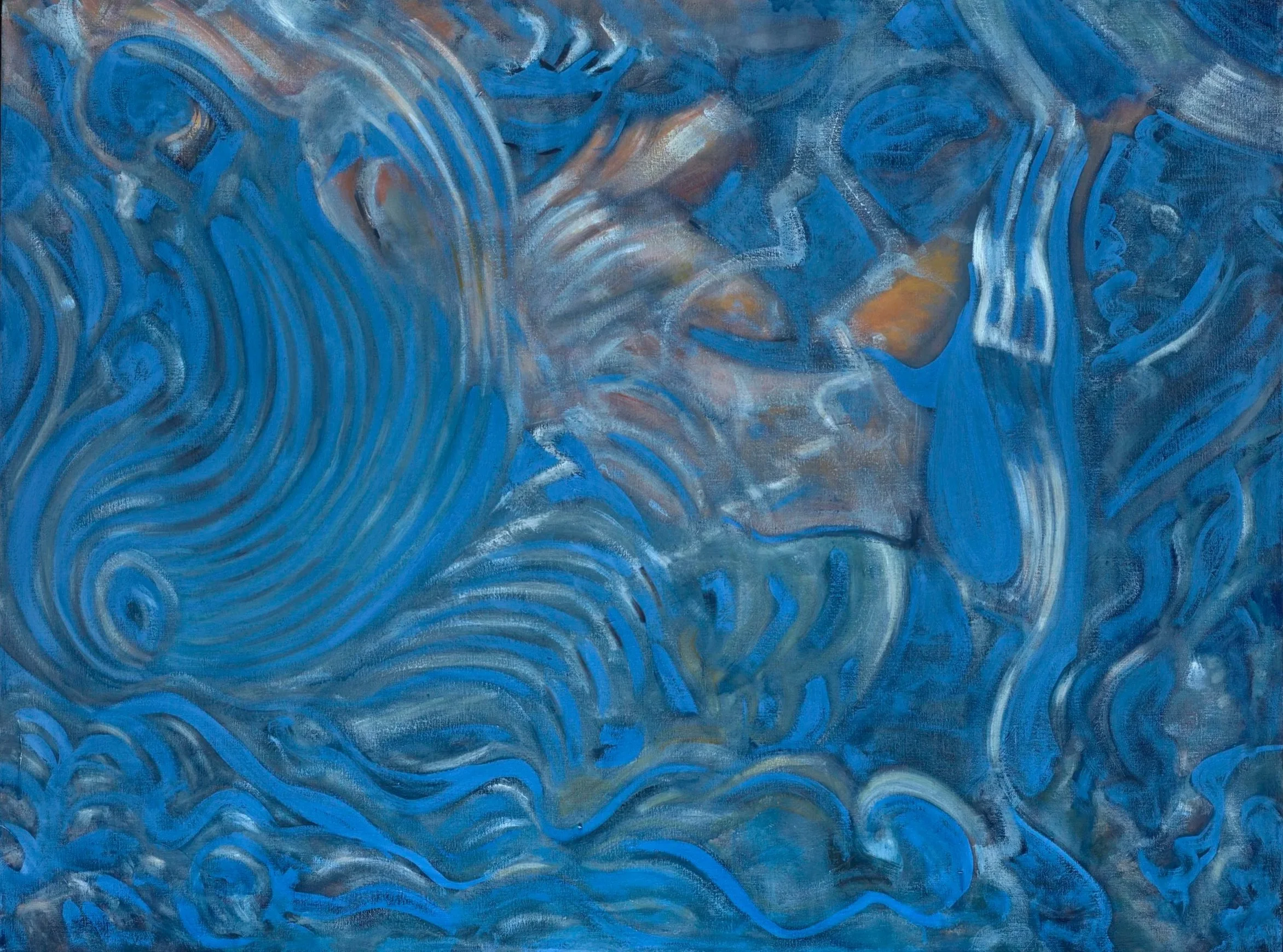
Patterns | Oil on canvas | 90 × 120 cm
What mediums do you use and how do you use these?
I typically just use linseed oil, but occasionally liquin when I want a very flat and glossy finish. Generally, I try and use the oil paint directly as it comes. I use Michael Harding’s paints, which are excellent.
What canvas do you prefer and why?
For my main paintings, I use handmade canvases from G&S in No. 13 material, which is ideal for portraits. Otherwise, I am happy to use boards or wood.
If there was ONE product you could not live without, what would it be?
Depends how you define product and ONE. A full range of Michael Harding oil paints might be ONE product, but I would still need brushes and a canvas… If it were just a pencil, I would still need paper, so to have truly ONE product and nothing else, it would have to be clay. At least then I could make something.
You’re going to a Desert Island, what art materials are you bringing with you?
I would empty G&S and take it with me. I would never get bored. I could gold leaf the palm trees and spray paint the rocks, turn the easels into a frame for a large tent, use the canvases as well, canvas for the tent, paint the outside in oil paint to fend off the rain and the inside in acrylic to reduce the pong. I would produce many sea paintings in different media, such as ink, water colour, gouache, pastels and of course, oil and acrylic. I would use all the dud work as firelighters and build an art gallery to exhibit my work to the wildlife.
Describe your process to us, do you plan a painting beforehand, or do you work quite intuitively?
I tend to plan my work, but not extensively. I find that the key is to get the composition right. If I’m doing a portrait, the size and placement of the head on the canvas is essential. If a larger work, then shape of the body and how it fits in the canvas needs some thinking. I use a computer to help with this process, for example with my series on artists where I combined a portrait of the artist with their artworks, I created collages on screen to see what the images could look like and then used that to create the work. For my more recent abstract work, I have used the golden mean as the only formal composition tool and then worked with colours to build up the image with thick layers of paint. In this situation, intuition is a much better tool. I maintain an idea of what emotion I wish to express and then let the paint do the talking.
Previously, you have worked in just OIL, but for this exhibition you started using ACRYLIC. How do these two mediums work differently/together? What advice would you give to someone first starting to paint using both?
I started painting four years ago exclusively in oil paint. It took a long time to get comfortable with it. I like to work quite fast, but it is very easy to make a mess with oil paint if you rush things. The Alla Prima method is very popular, but not easy to master and frankly a more complex painting takes time to evolve, so you need patience to do each stage of a painting at the right time and pace. I tend these days to build up a mono colour image first and when it is dry, build up the colour afterwards. To avoid getting impatient, I work on several paintings at once which gives time for each painting to dry enough for the next stage. Acrylic on the other hand has been totally different. It dries immediately. I love using the Golden brand of acrylic. When I was a student the quality of paint was poor, but Golden is amazing, just as good as Oil in terms of pigment quality. However, although you can use media to slow the drying speed, I find that with acrylic you need to think in terms of one colour at a time. You can’t prepare you palette with the range of paints you wish to use like you would with oils, because it all dries out before you get round to it. If you make a mix of paints on your palette to get a certain hue, by the time you get back to it, it has dried out and you need to mix it again. So I find Acrylic painting needs more planning where I go from mixed colour to mixed colour, step by step. This leads to a bolder contrast in my work compared to oil painting. I find acrylic especially useful for abstract work as it allows you to work fast even when you put on thick layers of paint, as it dries so quickly.
Who and what inspires you? Are there any particular artists that you admire? What is one artwork that has inspired Into the Deep?
My absolute favourite painters are Velasquez, Rembrandt, Botticelli and Singer Sargent. However, I am also a big fan of Pollock and Rothko. In my latest exhibition I wanted to express more emotion rather than images and this led me to use abstraction. The show documents the process starting with a seaside painting with a faded image of a young boy, then moving to distorted and submerged figures underwater, this then moves to patterns of water and limbs and then to dark expanses of blue that could be sea and sky but are not trying to depict anything. These are then followed by pure abstract images in other colours that conjure up different feelings in me and hopefully other people. The show ends with a portrait of a woman.
What do you think drew you to painting abstract and moving away from your traditional portraiture?
The need to express emotion rather than share an image. I think that going forward I will probably combine these two approaches, much in the way my latest self portrait does.
Which is your favourite painting in Into the Deep and why?
I cannot answer this question as I like them all for different reasons.
Into the Deep is on show at the Gallery from 30 March to 18 April.